 AyRoo
AyRoo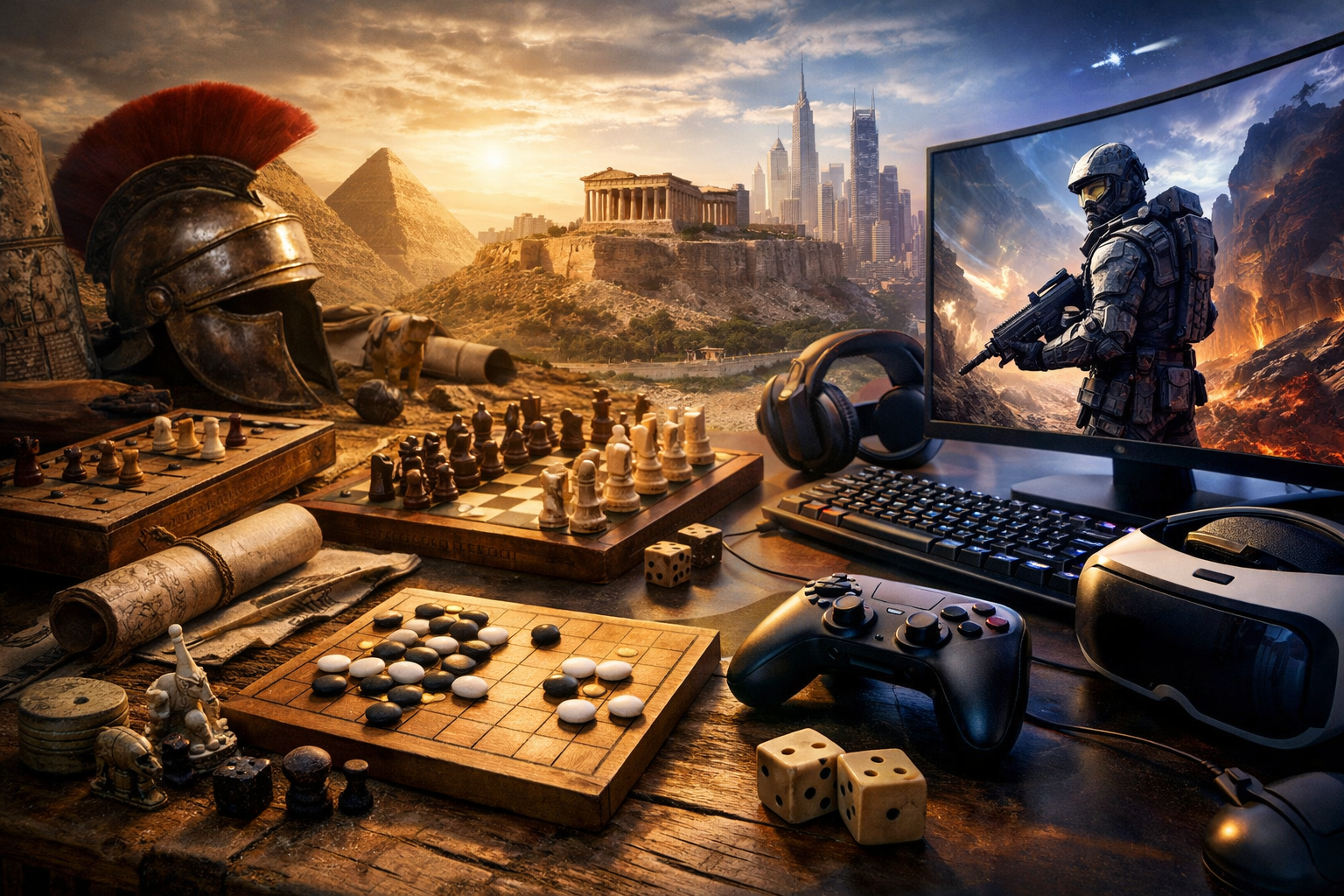
The Long Human Story of Play
The history of games is deeply connected to the history of civilization itself. Long before modern consoles, trading cards, and organized esports, people in ancient communities created games for amusement, education, spiritual symbolism, and social bonding. Games are more than diversions; they reflect the values, technologies, and daily lives of the people who play them. Across continents and centuries, they have served as tests of skill, tools of strategy, and stages for storytelling.
Archaeological discoveries show that games appeared wherever humans formed stable societies. Early examples include carved stones, marked boards, dice, and pieces made from bone, ivory, or clay. These objects suggest that play was not a luxury but a recurring feature of human culture. Whether competitive or cooperative, simple or complex, games created structured ways for people to interact.
Ancient Origins of Board Games
Some of the earliest known games come from Mesopotamia, Egypt, India, and China. The Royal Game of Ur, played in Mesopotamia more than 4,000 years ago, is among the oldest board games ever discovered. Its decorated board and racing mechanics show that even early games could combine chance, movement, and tactical decision-making.
In ancient Egypt, Senet became one of the best-known games of the ancient world. Found in tomb paintings and burial sites, Senet appears to have had both recreational and spiritual significance. Scholars believe it may have symbolized the soul’s journey into the afterlife, demonstrating that games could carry religious meaning as well as entertainment value.
In India, early forms of strategy games eventually contributed to the development of chess. Chaturanga, often considered a distant ancestor of chess, represented military divisions such as infantry, cavalry, elephants, and chariots. This connection between game rules and real-world institutions reveals how games often mirrored political and military ideas.
China also produced influential traditions of play, including Go, a game with remarkably simple rules but extraordinary strategic depth. Go emerged more than 2,500 years ago and remains one of the world’s most respected strategy games. Its endurance illustrates a key feature of great games: elegant systems can remain compelling across many generations.
Games in the Classical and Medieval Worlds
As trade routes expanded, games traveled with merchants, armies, and migrants. The movement of ideas across Asia, the Middle East, Europe, and Africa encouraged adaptation and reinvention. Dice games became widespread in Greece and Rome, where they were popular despite moral criticism from some leaders and philosophers. Roman society embraced many forms of competition, from board play to athletic contests in public arenas.
During the medieval period, games continued to evolve. Chess spread from India through Persia and the Islamic world into Europe, where it was transformed in both style and symbolism. European chess pieces came to reflect feudal society, with kings, queens, bishops, and knights. By the late medieval and early modern eras, rule changes had made the game faster and more dynamic, shaping the version known today.
Card games also gained prominence during this time. Likely originating in China before spreading westward, playing cards became especially popular in the Islamic world and Europe. Over time, regional decks and rule variations produced entirely new traditions, including trick-taking games, gambling games, and eventually modern family card games.
The Rise of Organized Recreation
While games had always existed, the modern idea of standardized, widely distributed games grew stronger in the 18th and 19th centuries. Industrialization made printed boards, cards, and rulebooks cheaper and more accessible. Urbanization also changed leisure habits, creating larger audiences for organized recreation. Families increasingly gathered around parlor games, educational games, and commercial board games designed for home entertainment.
At the same time, many physical games became formalized as modern sports. Football, cricket, baseball, and other games developed written rules, clubs, leagues, and governing bodies. This standardization allowed games to move beyond local custom and become national or even international institutions. Competitive play gained new prestige, and spectatorship became a major part of gaming culture.
The 19th century also saw game makers embrace themes of morality, travel, empire, and commerce. Board games often reflected the social attitudes of their age. Some were designed to teach children discipline or practical knowledge, while others offered fantasy, adventure, or satire. In every case, games remained mirrors of the societies that produced them.
The Digital Revolution
The 20th century transformed the history of games more dramatically than any previous era. Traditional tabletop and athletic games remained important, but electronic technology created entirely new possibilities. Early computer scientists and engineers experimented with interactive programs, leading to primitive digital games in the mid-20th century. By the 1970s and 1980s, arcade machines and home consoles brought video games into mainstream life.
Titles such as Pong, Space Invaders, and Pac-Man demonstrated that digital play could be simple, competitive, and massively popular. Soon, improvements in graphics, sound, and computing power allowed games to become more immersive. Adventure games, role-playing games, simulations, and multiplayer titles expanded the medium into a broad creative industry.
The late 20th and early 21st centuries introduced online gaming, mobile gaming, and global multiplayer communities. Games were no longer confined to living rooms or arcades. They became social platforms, storytelling environments, and professional competitions. Esports, streaming, and game design education have further established gaming as a major part of modern culture and economy.
Why the History of Games Matters
Studying the history of games helps us understand how humans learn, compete, and connect. Games preserve cultural memory while also encouraging innovation. Ancient board games reveal social hierarchies, trade networks, and religious beliefs. Modern video games reveal technological ambitions, artistic experimentation, and changing ideas about community.
- Games teach strategy, cooperation, and problem-solving.
- They reflect social values and historical change.
- They travel across borders, carrying ideas between cultures.
- They adapt to new technologies without losing their core appeal.
- They create shared experiences across age groups and generations.
From carved boards in ancient tombs to digital worlds shared by millions, games have remained one of humanity’s most enduring inventions. Their forms may change, but their purpose remains strikingly familiar: to challenge, entertain, connect, and inspire. The history of games is ultimately the history of people finding meaning in play.