 AyRoo
AyRoo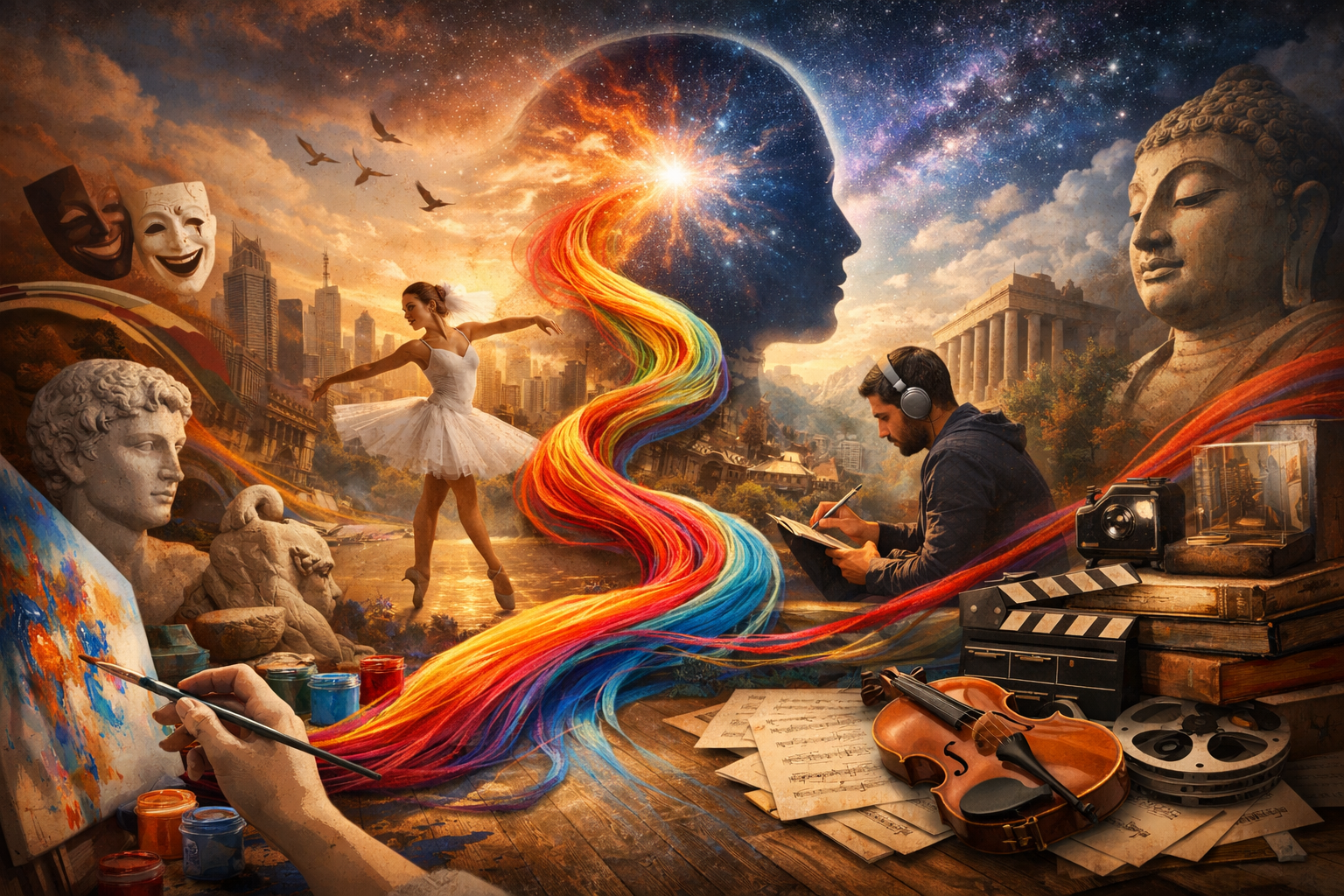
What We Mean by “The Arts”
The arts are a broad family of practices that use skill, imagination, and form to communicate experience. They include what people often call the “fine arts” (painting, sculpture, music), the “performing arts” (theater, dance), literary arts (poetry, fiction, spoken word), and applied or design arts (architecture, graphic design, fashion). In everyday life, these categories overlap constantly: a film combines writing, acting, music, photography, editing, and design; a public mural can include typography, social history, and community planning.
What unites these fields is not a single technique but a shared intent: to shape attention. Artists select materials, rhythms, images, and structures so that audiences can feel, notice, and reflect in ways ordinary communication rarely achieves.
Why the Arts Matter in Society
Across cultures, the arts have served as both mirror and engine: they reflect what a community believes while also helping that community change. A song can carry language across generations; a novel can test moral choices inside a safe imaginative space; an exhibition can make visible what has been ignored. In this sense, the arts function as a form of public thinking—sometimes celebratory, sometimes disruptive.
The social value of the arts is not limited to large institutions like museums or concert halls. Street performances, local craft traditions, community theater, fan fiction, and home studios all contribute to cultural continuity. Even informal creativity—sketching, dancing, remixing—builds shared references that help people feel part of something larger than themselves.
Core Functions of Artistic Practice
Expression and Emotional Literacy
Art gives shape to feelings that are hard to name. A melody can communicate grief without explanation; a photograph can hold tenderness and tension at once. Over time, engaging with art can expand emotional vocabulary, allowing people to recognize nuance—ambivalence, longing, awe—and respond more thoughtfully to themselves and others.
Storytelling, Memory, and Identity
Stories are cultural infrastructure. They teach values, record history, and set the boundaries of who is seen. The arts preserve memory not only through facts but through sensory detail: the cadence of a poem, the color palette of a landscape, the choreography of a ritual dance. These elements anchor identity—personal and collective—especially for communities whose histories have been marginalized or fragmented.
Critique and Civic Imagination
Many artworks ask viewers to reconsider what they accept as normal. Satire exposes contradictions; documentary theater can humanize statistics; speculative fiction can model alternative futures. By making problems visible and futures imaginable, the arts support civic life, encouraging dialogue where polarization might otherwise shut it down.
Craft, Mastery, and the Pleasure of Form
Not all art is primarily message-driven. Much of its power comes from form: harmony, composition, balance, texture, pacing. Mastery—whether in ceramics, jazz improvisation, or calligraphy—invites deep attention. The pleasure of form is not superficial; it trains patience and perception, reminding audiences that meaning can be built through structure.
From Studio to Stage: How Art Is Made
Artistic creation is often imagined as sudden inspiration, but most work emerges through cycles: research, experimentation, drafts, critique, revision, and performance. A painter may explore studies and underpaintings before the final canvas; a choreographer develops phrases, tests them with dancers, revises timing, and adjusts to the physical realities of bodies in space; a composer might iterate themes until the piece “breathes.”
Collaboration is equally central. Films and theater rely on ensembles; music depends on listening across a group; architecture requires dialogue with engineers, clients, and communities. Even solitary art forms are shaped by networks—teachers, traditions, tools, audiences, and the economics that determine time and access.
The Arts in the Digital Age
Digital tools have expanded who can create and how work circulates. A smartphone can be a camera, studio, and distribution channel; software can simulate instruments, design environments, or animate ideas. Online platforms enable niche communities to flourish, but they also influence what gets made through algorithms that reward speed and visibility.
New questions follow: How do artists protect authorship in a world of easy copying? How do audiences evaluate authenticity when images and audio can be generated or manipulated? How do institutions preserve digital works that may depend on rapidly changing technologies? These tensions are not merely technical—they shape aesthetics, ethics, and trust.
Arts Education: Building Skills Beyond Art
Learning the arts develops transferable capacities: close observation, disciplined practice, collaboration, and the ability to interpret ambiguous information. Whether a student is analyzing a poem’s imagery or refining a musical phrase, they practice attention and iterative improvement—skills relevant to science, leadership, and everyday problem-solving.
Arts education also supports communication. Performing teaches presence and listening; visual work teaches composition and clarity; writing teaches structure, voice, and empathy for different perspectives. Importantly, the arts can welcome learners who do not thrive under single-answer models, offering multiple pathways to competence and confidence.
How to Engage With the Arts More Deeply
You do not need specialized knowledge to participate meaningfully. A useful approach is to combine curiosity with patience: spend time with a work, notice what it makes you feel, and ask what choices created that effect. Over time, your “art vocabulary” grows naturally.
- Practice slow looking or listening: revisit a piece and track what changes in your perception.
- Learn a little context: understanding a genre, historical moment, or technique can open layers of meaning.
- Support local creators: attend community performances, buy prints or recordings, and share thoughtful feedback.
- Make something yourself: a sketchbook, a short poem, or a dance practice builds appreciation from the inside.
- Discuss respectfully: art invites multiple interpretations; disagreement can be productive when grounded in observation.
A Continuing Conversation
The arts endure because they adapt. They carry tradition and experiment at the same time, creating a continuous conversation between past and present. In a world saturated with information, art helps people recover attention, feel complexity without panic, and imagine alternatives to what already exists.
Whether encountered in a grand museum or a small neighborhood stage, the arts offer a distinctive kind of knowledge: embodied, emotional, and reflective. They remind us that humans do not live by facts alone—we also live by form, rhythm, image, and story.