 AyRoo
AyRoo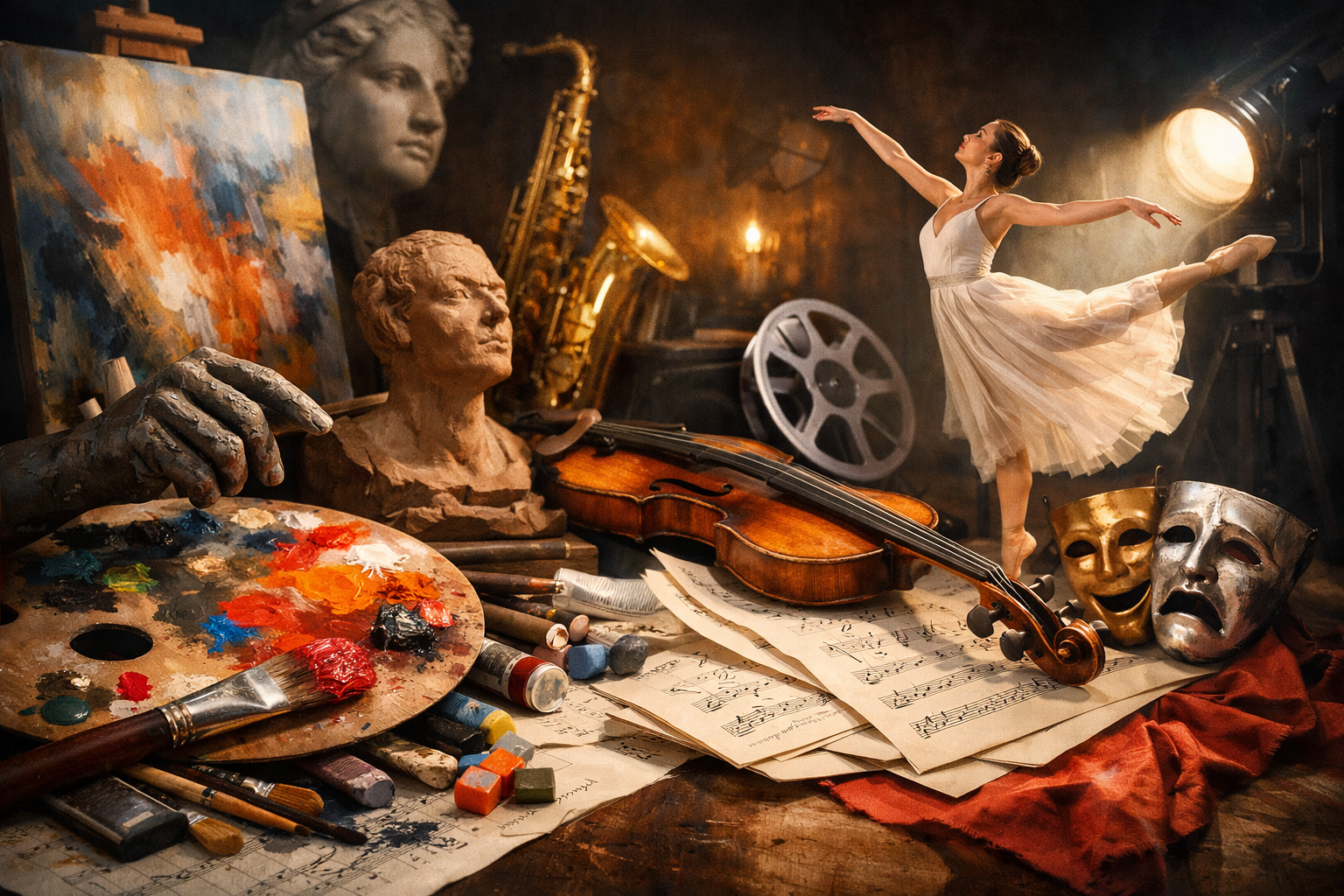
Understanding What “Arts” Really Means
The word arts covers a wide territory: painting and sculpture, music and dance, theater and film, literature and poetry, design and architecture, crafts, digital media, and emerging forms that blend technology with human imagination. What links these diverse practices is not a single technique but a shared purpose—using form, rhythm, image, sound, or movement to communicate ideas and emotions that are difficult to capture through ordinary speech.
Arts can be personal (a sketchbook page made in private) or collective (a festival performance), traditional (a classical sonata) or experimental (interactive installations). They can preserve heritage, challenge power, comfort audiences, provoke debate, or simply invite people to see everyday life differently.
Major Domains of the Arts
While categories overlap, the arts are often discussed in several broad domains. Each domain has its own tools and conventions, yet they frequently borrow from one another.
- Visual arts: Painting, drawing, photography, sculpture, printmaking, and mixed media—centered on composition, color, texture, and spatial perception.
- Performing arts: Music, theater, dance, and performance art—centered on time, presence, interpretation, and audience interaction.
- Literary arts: Fiction, nonfiction, poetry, drama, and spoken word—centered on language, voice, structure, and storytelling.
- Design and applied arts: Graphic design, fashion, industrial design, interior design, and crafts—where aesthetics meet function and user experience.
- Media arts: Film, animation, video art, digital art, game design, and immersive media—often combining sound, image, narrative, and interactivity.
Why the Arts Matter to Individuals and Societies
Arts matter because they shape how people interpret the world. They offer ways to process grief, joy, conflict, and belonging. A song can become a time capsule for a generation; a mural can reclaim public space; a novel can make distant lives feel close. The arts are also a record of human curiosity—evidence that people have always sought beauty, meaning, and connection.
On a social level, arts support civic life by encouraging empathy and dialogue. They can critique injustice, imagine alternatives, and amplify voices excluded from mainstream narratives. Even when they avoid politics entirely, the arts still influence values by reinforcing or challenging what a community considers admirable, normal, or possible.
Arts as a Form of Knowledge
Not all knowledge is statistical or literal. The arts generate experiential knowledge: what it feels like to stand in another person’s shoes, to sense uncertainty, to navigate ambiguity. A choreographer can explore tension and release in the body; a filmmaker can show how memory distorts time; a poet can compress a life into a few lines. These are not merely “messages”—they are ways of thinking.
How Art Is Made: Process, Practice, and Craft
Behind every finished work is a process that includes experimentation, revision, and technical learning. “Talent” often gets overemphasized, while practice and craft are overlooked. Artists develop sensitivity to materials (paint viscosity, clay moisture, breath control, camera exposure), but they also develop habits of attention—observing light, listening for nuance, noticing patterns in behavior.
Many art forms rely on constraints. A sonnet’s structure, a film’s budget, or the physics of a stage set can become creative engines. Constraints force choices, and choices create style. Over time, a maker’s recurring choices become a recognizable voice.
The Role of Critique and Feedback
In many artistic traditions, critique is not about “liking” or “disliking” but about clarity and impact. Feedback asks: What is the work trying to do? What is it actually doing? Where does it succeed, and where is it confusing? Learning to give and receive critique is one of the most practical skills in the arts, because it strengthens both technique and intention.
Arts in Daily Life: Participation Beyond the Gallery
The arts are not reserved for museums, concert halls, or elite institutions. They live in daily routines: playlists that regulate mood, home cooking presented with care, clothing chosen as self-expression, neighborhood festivals, memes and short-form videos, and handmade gifts. Participation can be as simple as reading poems before bed or drawing during a commute.
Community arts programs—public theater, youth bands, open-mic nights, library workshops—make creativity accessible and reduce the idea that art belongs only to professionals. When people make art together, they build social trust, shared memories, and spaces where difference can be negotiated rather than feared.
The Digital Shift: New Tools, New Questions
Digital technology has expanded what art can be. Artists now work with tablets, 3D modeling, motion capture, AI-assisted tools, and virtual production. Distribution has also changed: a dancer can reach global audiences through short videos, and an illustrator can build a career through online communities.
These changes come with questions about authorship, originality, and sustainability. Who owns a digital artwork? How should creators be credited when tools automate parts of the process? How do algorithms shape taste? The digital era doesn’t replace traditional arts—it adds layers of possibility and complexity.
How to Engage with the Arts More Deeply
Engaging with the arts is a skill, not a test. You don’t need specialized vocabulary to start—curiosity and attention are enough. The key is to slow down and let a work affect you before you judge it.
- Spend time: Look longer, listen again, or reread. Meaning often emerges through repetition.
- Ask simple questions: What do I notice first? What emotions arise? What details support that feeling?
- Learn context selectively: A bit of background—era, medium, artist intention—can deepen understanding without dictating it.
- Try making something: Even small attempts (a collage, a short story, a rhythm on a table) build empathy for the craft.
- Share interpretations: Discussing art with others reveals how diverse perception can be.
Conclusion: Arts as a Human Necessity
Arts endure because they meet needs that purely practical systems cannot. They help people name the unnamed, feel the unfelt, and imagine the unbuilt. Whether created with oils, instruments, voices, words, code, or movement, art is a living language—one that evolves as societies evolve. To engage with the arts is to participate in humanity’s ongoing conversation about what matters, what hurts, what heals, and what might come next.