 AyRoo
AyRoo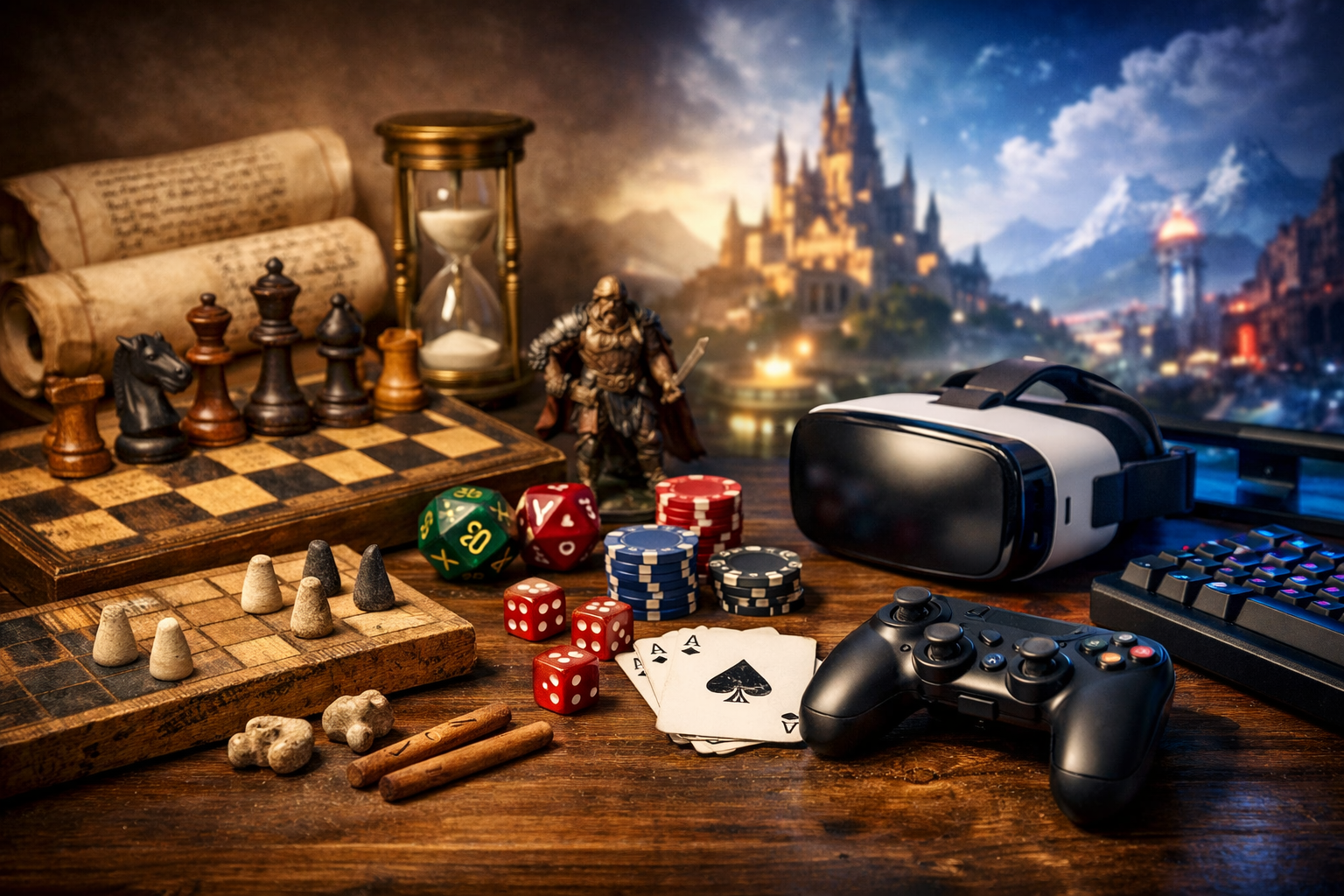
The Enduring Story of Games
The history of games is, in many ways, the history of human society itself. Long before screens, controllers, and online platforms, people invented structured forms of play to pass time, teach skills, strengthen communities, and explore ideas about luck, strategy, and power. From carved stones and painted boards to cards, dice, athletic contests, and immersive digital experiences, games have continually adapted to the values and technologies of each era.
What makes games so remarkable is their flexibility. They can be competitive or cooperative, simple or deeply complex, local or global. Some were created for religious purposes, some for military training, and others purely for entertainment. Across centuries, games have reflected trade routes, class divisions, scientific advances, and changing ideas about leisure. Their evolution offers a unique lens through which to understand culture and civilization.
Ancient Origins of Play
Archaeological evidence shows that games are thousands of years old. Some of the earliest known board games were found in ancient Egypt and Mesopotamia. Senet, played in Egypt as early as around 3100 BCE, used a gridded board and counters. Though its exact rules remain debated, scholars believe it combined strategy with spiritual symbolism, possibly representing the journey to the afterlife.
In Mesopotamia, the Royal Game of Ur appeared around 2600 BCE. Its decorated board and racing mechanics suggest that even early urban societies valued both craftsmanship and recreation. Dice-like objects and marked playing pieces found in ancient sites across Asia, Africa, and Europe show that humans consistently developed rule-based play wherever communities formed.
Ancient games were often more than pastime activities. They could express religious beliefs, indicate social status, or reinforce ideas about fate and fortune. In many early cultures, the throwing of lots or dice had connections to divination, blurring the line between gaming and ritual.
Games in Classical Civilizations
As civilizations expanded, games became more diverse and more widely shared. In India, early versions of games such as chaturanga emerged, widely regarded as a precursor to chess. Chaturanga modeled military structure with pieces representing infantry, cavalry, elephants, and chariots, showing how games could mirror political and military realities.
In China, strategic and intellectual games flourished. Go, with origins dating back over two millennia, became one of the world’s most respected abstract strategy games. Its elegant rules and immense complexity made it a symbol of discipline, foresight, and cultivated thought. Other games, including liubo and various tile-based traditions, also formed part of a rich gaming heritage.
Greek and Roman societies embraced both physical and tabletop play. Athletic competitions such as the Olympic Games had religious roots but also became displays of identity and prestige. Meanwhile, Roman citizens enjoyed dice games, board games, and gambling, sometimes despite legal restrictions. The spread of empire helped move games across regions, making them tools of cultural exchange.
The Medieval and Early Modern Transformation
During the medieval period, games continued to evolve through trade, conquest, and migration. Chess traveled from India through Persia into the Islamic world and then into Europe, where its pieces and rules gradually changed. By the late medieval period, chess had become a powerful symbol of intellect, rank, and courtly culture. The transformation of the queen into the most powerful piece in the game is one of the most famous examples of how social ideas can shape game design.
Card games also spread widely during this era. Likely arriving in Europe from Asia through Islamic territories, playing cards became enormously popular by the fourteenth and fifteenth centuries. They inspired local suits, regional rules, and an entire culture of gambling, trick-taking, and social gathering. The invention of printing helped standardize decks and made them more accessible to broader populations.
Many traditional games also remained rooted in villages and households. Dice, race games, outdoor contests, and folk competitions filled communal life. Though elites often had access to expensive sets and specialized leisure, ordinary people created and preserved games using simple materials and oral traditions.
The Rise of Commercial Board Games
The industrial age changed the history of games in profound ways. Mass production made it easier to manufacture boards, cards, tokens, and rulebooks at scale. During the nineteenth century, publishers began marketing games to families, children, and middle-class consumers. These games often reflected the moral values of the time, teaching discipline, thrift, geography, or proper behavior.
By the late nineteenth and early twentieth centuries, games became increasingly commercial and branded. Titles were sold not just as amusements, but as educational tools and household entertainment. This period laid the foundation for the modern board game industry, where packaging, artwork, and marketing became central to success.
- Mass production lowered costs and expanded access.
- Printed rules made games easier to standardize and share.
- Urban leisure culture increased demand for home entertainment.
- Publishers began targeting specific audiences, including children and families.
The Twentieth Century: From Parlor Tables to Arcades
The twentieth century saw extraordinary diversification in games. Board games such as Monopoly, Scrabble, and Risk entered homes around the world, each reflecting different fantasies of wealth, language, conquest, or strategy. At the same time, sports grew into major global industries, and card games remained deeply embedded in social life.
A revolutionary change arrived with electronic gaming. Early experiments in the mid-twentieth century led to arcade machines and home consoles in the 1970s and 1980s. Video games introduced moving graphics, responsive systems, and entirely new forms of interactive storytelling. Titles like Pong, Space Invaders, and Super Mario Bros. helped redefine what a game could be.
Arcades became social hubs, while consoles brought gaming into private homes. Personal computers expanded the field further, enabling simulation games, role-playing games, and online multiplayer experiences. As graphics improved and storage increased, video games developed into one of the most influential entertainment forms in history.
The Digital Age and Global Gaming Culture
Today, games exist across mobile devices, consoles, computers, cloud services, and virtual platforms. Competitive gaming has become esports, streaming has turned gameplay into performance, and online communities connect millions of players across borders. Modern games can be artistic, educational, social, cinematic, or highly competitive.
Yet despite advanced technology, many core elements remain ancient: rules, goals, uncertainty, challenge, and shared meaning. Whether someone is playing chess, tossing dice, building in a sandbox world, or competing in a global tournament, they are participating in a human tradition that stretches back millennia.
The history of games is not a simple march from primitive to advanced. Instead, it is a layered story of invention, adaptation, and continuity. Old forms survive alongside new ones, and each generation reshapes play to fit its world. Games endure because they satisfy something deeply human: the desire to test ourselves, tell stories, explore systems, and connect with others through structured play.