 AyRoo
AyRoo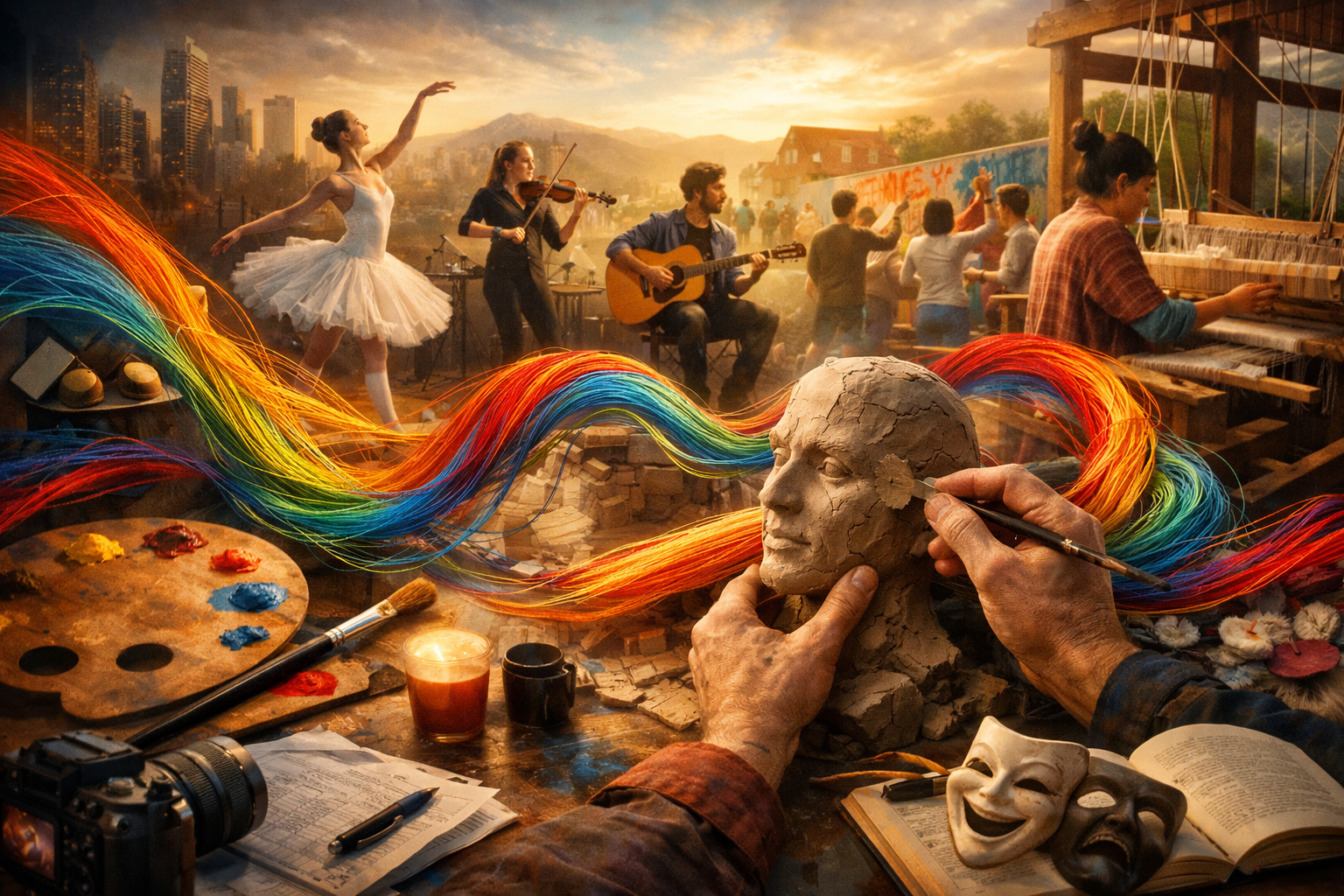
What We Mean by “Arts”
The arts describe a wide range of human activities that use imagination, skill, and intention to create experiences—visual, auditory, performed, written, or digital. At their core, the arts organize feeling and thought into forms that can be shared: a painting that holds a moment in color, a poem that compresses an idea into rhythm, a dance that makes emotion visible through movement. While styles and traditions differ across time and geography, the impulse is consistent: to make meaning and to communicate it beyond ordinary language.
Arts are often grouped into categories such as visual arts (painting, sculpture, photography), performing arts (theatre, dance, music), literary arts (poetry, fiction, essays), and media arts (film, animation, interactive and digital work). In practice, these boundaries regularly blur—an installation might use sound and projection, a theatre piece might incorporate documentary video, and a song might be released as an immersive audiovisual experience.
Why Arts Matter: Core Functions in Human Life
People sometimes treat art as “extra,” but historically it has served essential roles: recording histories, shaping belief systems, building identity, and challenging power. Arts help individuals process complexity—grief, joy, uncertainty, wonder—when straightforward explanation feels too small. They also help groups negotiate shared values by offering common symbols and stories.
- Expression: turning internal experience into communicable form.
- Connection: building empathy by letting audiences inhabit perspectives other than their own.
- Memory: preserving personal and collective histories through images, songs, monuments, and narrative.
- Inquiry: asking “what if?” and “why?” through experimentation with materials and ideas.
- Delight: creating pleasure and play, which can be restorative and motivating.
A Brief Look at Major Art Forms
Visual Arts
Visual arts shape how we see. From ancient cave paintings to contemporary street murals, the visual arts translate perception into composition—choices of color, line, texture, scale, and space. Even a simple sketch involves decisions: what to include, what to omit, and what viewpoint to take. Photography and design, meanwhile, sit at the intersection of craft and technology, revealing how tools influence aesthetic possibilities and how images can persuade as well as document.
Performing Arts
Performing arts happen in time and often in community. Music organizes sound into patterns that can soothe, energize, or unsettle. Theatre turns conflict into dialogue and action, letting audiences witness a story unfold live. Dance uses the body as both instrument and image, expressing rhythm, culture, and personal identity without needing words. These forms are also deeply collaborative: performers, directors, choreographers, technicians, and audiences co-create the final experience in each unique performance.
Literary Arts
Writing is a technology of imagination. Poems distill language to its most charged elements—sound, metaphor, cadence—while fiction and nonfiction build worlds, arguments, and intimate portraits of human life. Literary arts train attention: they ask readers to slow down, interpret nuance, and track the hidden logic of character and theme. In a culture of quick scrolling, sustained reading can be both a refuge and a discipline.
Media and Digital Arts
Film, animation, games, and interactive works expand art into immersive environments. Media arts combine many languages at once—visual composition, music, performance, editing, typography, and code. Digital tools also raise new questions: who owns an image, how algorithms influence taste, and what authenticity means in an era of AI-generated content. For artists, these tools can be liberating, but they also demand critical literacy from audiences.
Arts as Culture: Identity, Tradition, and Innovation
Arts carry cultural DNA. Folk songs, textile patterns, architecture, and ceremonial performances transmit values across generations, teaching people how to belong. At the same time, arts evolve as communities change. Innovation often comes from conversation across borders—migration, trade, and modern communication allow styles to mingle, producing new genres and hybrid forms.
This relationship between tradition and experimentation is not a conflict but a cycle: artists inherit techniques and stories, then adapt them to present realities. A contemporary mural can honor ancestral motifs while addressing current social issues; a composer can sample older recordings to create something distinctly new.
The Arts in Education and Skill-Building
Arts education is not only about making “artists.” It builds transferable skills: observation, patience, iteration, critique, and the ability to present ideas clearly. Creating art teaches that early attempts are drafts, not verdicts—a mindset that supports problem-solving in any field. Learning an instrument trains coordination and listening; acting develops presence and interpretation; drawing refines attention to detail.
Equally important is arts literacy: understanding how meaning is made through composition, symbolism, and context. This helps people navigate image-heavy environments—advertising, social media, political messaging—with more awareness and agency.
Arts, Economy, and Public Life
Arts also have practical impact. Creative industries include design, film, publishing, music, architecture, and more, generating jobs and shaping city identities. Cultural events bring people into public spaces, supporting local businesses and encouraging civic participation. Museums and galleries preserve heritage, while community arts centers provide accessible entry points for newcomers.
Yet the value of arts is not only economic. Public art can transform daily routines into moments of reflection. A small concert, a neighborhood festival, or a library reading can strengthen social ties in ways that are difficult to measure but easy to feel.
How to Engage with the Arts (Even If You Don’t Feel “Artistic”)
Engaging with arts doesn’t require expertise—only curiosity and willingness to spend time with a work. Start close to home: a local exhibition, a community theatre production, an open mic night, or a public mural walk. When you encounter a piece that confuses you, treat that as an invitation rather than a failure; many artworks are designed to be questions, not answers.
- Look slowly: spend a few minutes with one artwork instead of rushing through many.
- Ask simple questions: what do I notice first, and why might the artist want that?
- Learn the context: a short wall label, program note, or interview can open meaning.
- Make something small: a sketch, a photo series, a short poem—practice builds confidence.
- Support creators: attend shows, buy prints, share credits, and respect usage rights.
A Continuing Human Conversation
Arts endure because they answer a persistent human need: to shape experience into forms that can be shared, questioned, and remembered. They help individuals express what feels unsayable and help societies see themselves more clearly—sometimes with pride, sometimes with discomfort, often with both. As tools and platforms change, the arts continue to adapt, but their purpose remains familiar: to connect imagination with reality, and to keep the conversation of culture alive.